
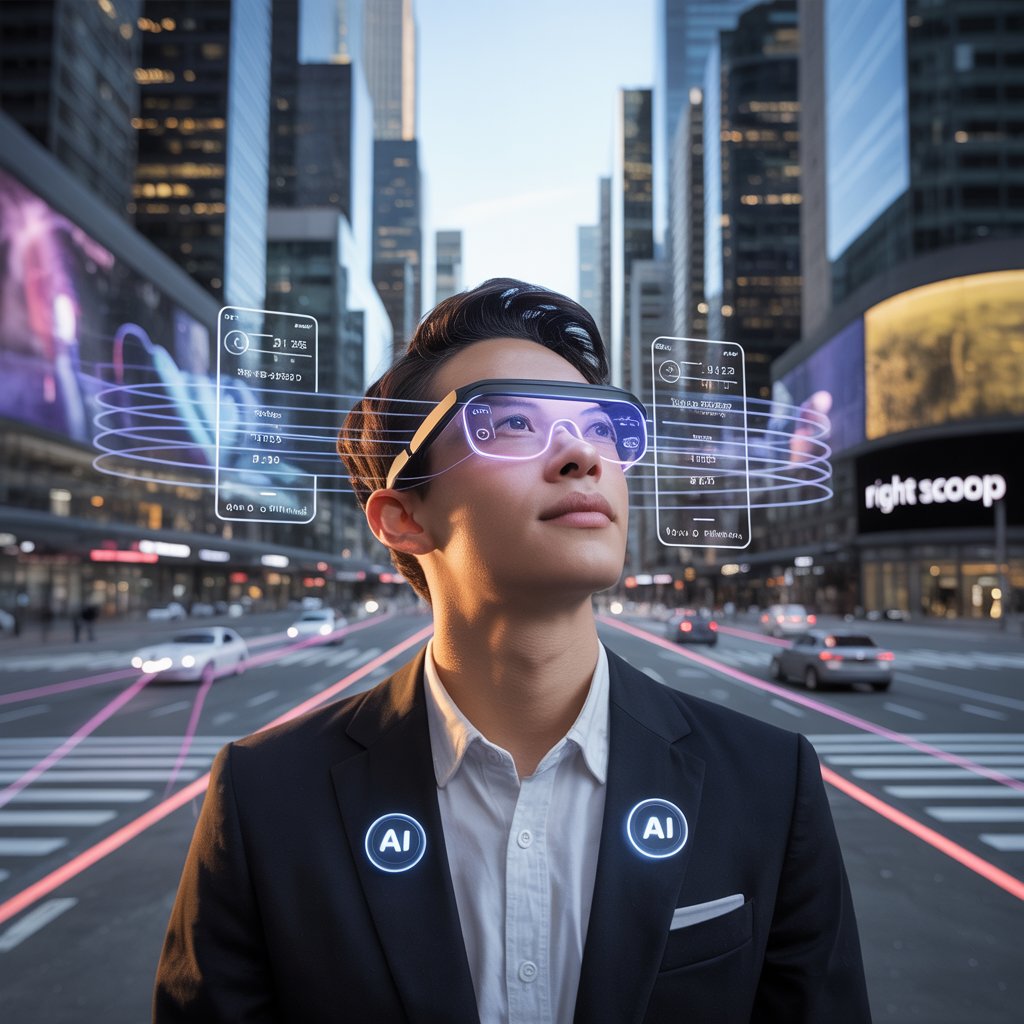
Imagine a world where your morning routine doesn’t start with fumbling for a rectangular slab of glass on your nightstand. Instead, a subtle voice in your ear nudges you awake, overlaying your view of the kitchen with a floating recipe as you brew coffee. This isn’t science fiction—it’s the vision tech giants are chasing right now. As we hit the mid-2020s, the smartphone, once a revolutionary device that reshaped society, feels like it’s running on fumes. Tech Giants Envision Future Beyond Smartphones, one driven by seamless integration of AI, augmented reality, and ambient tech that fades into the background of our lives. But how did we get here, and what’s the path forward? Let’s dive in.
The Slowdown of Smartphone Innovation
Smartphones exploded onto the scene in the late 2000s, turning pockets into portals for endless connectivity, entertainment, and productivity. Remember the thrill of the first iPhone in 2007? It wasn’t just a phone; it was a computer, camera, and GPS mashed into one. Fast-forward to 2025, and the excitement has dimmed. Incremental updates dominate—slightly better cameras, marginally faster processors, and batteries that last a tad longer. Market saturation plays a big role: nearly everyone who wants a smartphone already has one, with global shipments stabilizing around 1.2 billion units annually. In mature markets like the US and Europe, upgrade cycles stretch to three or four years as users hold onto devices longer.
User behavior is shifting too. We’re spending more time on screens than ever—averaging six hours a day—but fatigue is setting in. Notifications overwhelm, and the constant pull of social media apps breeds distraction. Tech Giants Envision Future Beyond Smartphones because they see these pain points as opportunities. Why stare at a screen when tech could anticipate needs without demanding attention? This plateau isn’t just about hardware; it’s cultural. Younger generations crave experiences over possessions, pushing companies toward immersive, hands-free alternatives.
What Comes After Smartphones?
The post-smartphone era isn’t about ditching devices entirely—it’s about evolving them into something more intuitive and less intrusive. Tech Giants Envision Future Beyond Smartphones where computing blends into our environment, powered by AI that understands context and anticipates actions. This shift draws from decades of sci-fi inspiration, but now, with advancements in AI and miniaturization, it’s becoming tangible. We’re talking ecosystems that span wearables, ambient sensors, and augmented interfaces, creating a web of connectivity without a central “phone.”
AR Glasses and Mixed Reality Headsets
At the forefront are AR glasses, lightweight frames that overlay digital information onto the real world. Apple, long rumored to be working on such tech, pivoted in 2025 from overhauling its Vision Pro headset to focusing on AI-powered smart glasses that rival Meta’s offerings. These aren’t bulky prototypes; they’re sleek, with built-in cameras for real-time object recognition and AI assistants that whisper directions or translate signs. Meta, meanwhile, showcased at its Connect 2025 event how AR glasses could transform social interactions, letting users share holographic moments in real time.
Google isn’t far behind, partnering with eyewear brands like Gentle Monster for AI-enabled frames set for 2026, integrating Gemini AI for seamless queries and visual overlays. Think navigating a city with turn-by-turn arrows floating in your vision, or identifying plants during a hike. Mixed reality headsets like Apple’s Vision Pro, updated with the M5 chip in October 2025 for faster processing, bridge the gap for immersive work or gaming. These devices signal a move toward spatial computing, where digital and physical worlds merge effortlessly.
Wearable Ecosystems and AI-Driven Assistants
Wearables are expanding from fitness trackers to full ecosystems. Smartwatches and earbuds now handle calls, payments, and health monitoring without a phone nearby. Huawei led the global wearable market in Q2 2025 with a 20.2% share, emphasizing health features like wheelchair mode for inclusive tracking. AI-powered devices take this further: imagine earbuds that translate languages in real time or suggest workouts based on your biometrics.
The future of wearable tech lies in integration. Google’s ambient computing strategy weaves AI across devices, turning wearables into proactive assistants that learn from your habits. No more pulling out a phone to check the weather—your watch vibrates with an alert, or glasses display it subtly. This ecosystem approach reduces reliance on a single device, distributing computing power for efficiency and battery life.
Spatial Computing and Ambient Technology
Spatial computing flips the script: instead of us adapting to tech, tech adapts to us. It’s about environments that respond intelligently—lights dimming as you enter a room, or a virtual workspace appearing on any surface. Tech Giants Envision Future Beyond Smartphones through ambient technology, where sensors and AI create “invisible” computing.
Meta’s AR/VR plans emphasize this, with tools for developers to build 3D experiences that feel natural. Picture a kitchen counter turning into a recipe guide via projected holograms, or collaborative meetings where remote colleagues appear life-sized. Ambient tech relies on edge AI to process data locally, minimizing latency and privacy risks. As 5G-A networks roll out, Huawei predicts this will fuel the mobile AI era by 2030, with seamless connectivity across devices.
Flexible, Modular, and Hybrid Devices
Foldables and rollables represent a bridge to the post-smartphone era. Samsung’s Galaxy Z TriFold, launched in October 2025, unfolds into a tablet-sized screen for multitasking, hinting at modular designs where devices adapt to needs. Hybrid devices combine phone functionality with XR capabilities, like Samsung’s Galaxy XR headset, which integrates AI for mixed reality experiences.
Modularity could mean snapping on modules for extra battery or cameras, extending device life and reducing e-waste. Next-gen mobile tech like this blurs lines between categories, paving the way for truly adaptable hardware.
How Major Tech Giants Are Preparing for a Post-Smartphone Future
Tech giants aren’t just talking—they’re investing billions. From R&D labs to strategic partnerships, they’re laying groundwork for a world where smartphones are relics. This preparation involves hardware innovation, software ecosystems, and bets on emerging tech like AI and XR.
Apple’s Vision Beyond the iPhone
Apple’s ecosystem has always been its strength, and now it’s extending to AR glasses and the Vision Pro. In 2025, Apple halted a Vision Pro refresh to prioritize AI glasses with multiple cameras for enhanced spatial awareness. The Vision Pro’s M5 update boosts AI integration, enabling features like real-time object manipulation in mixed reality.
Siri evolves into a proactive assistant, pulling data from wearables for personalized experiences. Apple’s focus on privacy—processing AI on-device—sets it apart, envisioning a seamless transition where iPhone users migrate to glasses for daily tasks.
Google’s Ambient Computing Strategy
Google’s strategy centers on ambient computing, where AI anticipates needs across devices. In 2025, it invested in Gentle Monster for smart glasses, integrating Gemini AI for voice and visual interactions. The Android XR showcase highlighted spatial computing, with apps converting 2D content to 3D.
Cloud ecosystems play a key role, with wearables like Pixel Watch handling offline tasks via edge AI. Google’s open-source Coral NPU platform aids developers in building AI into wearables, accelerating adoption.
Meta’s AR/VR World-Building Plan
Meta is all-in on AR/VR for future communication devices. At Connect 2025, it unveiled AI-powered smart glasses for immersive social and work experiences, though MR glasses were delayed to 2027. Horizon Worlds gets AI NPCs, making virtual spaces feel alive.
The plan: build a metaverse where work meetings happen in shared AR spaces, reducing travel and enhancing collaboration. Meta’s developer tools accelerate content creation, aiming for a billion users by 2030.
Samsung’s Device Innovation Roadmap
Samsung’s roadmap emphasizes foldables and XR. The tri-fold phone and Galaxy XR headset launched in 2025, with AI glasses in development alongside Google. Future chips like Exynos focus on low-power AI for wearables.
This hybrid approach—combining screens with AR—eases the transition, with innovations like micro-OLED displays for lightweight glasses.
Huawei’s Wearable-Centric Approach
Without full Google access, Huawei pivots to wearables, topping the market in 2025 with health-focused devices like the Watch 5. Its Xinghe Intelligent Network upgrades AI-centric infrastructure for seamless connectivity.
Global expansion emphasizes wearables as the core, with AR integration for emerging markets where affordability matters.
How Life Will Look Without Smartphones
Picture Sarah, a marketing exec in 2030. She wakes to her AR glasses gently brightening, displaying her schedule overlaid on her bedroom wall. No phone check—her earbuds read emails aloud during her run, while health data from her watch adjusts her playlist. At work, spatial interfaces let her manipulate 3D models with hand gestures, collaborating with remote teams in holographic space.
Evenings bring family time: future communication devices project games onto the table, or translate conversations with overseas relatives in real time. Travel? Glasses overlay directions and reviews on landmarks. This post-smartphone era feels liberating—tech serves us, not the other way around, fostering presence over distraction.
Barriers to a Post-Smartphone Reality
Hardware challenges loom large: miniaturizing powerful chips for glasses without overheating or draining batteries fast. Current prototypes like Meta’s Orion struggle with field of view and comfort.
User adaptation is tricky—many resist wearing tech on their face, echoing Google Glass’s privacy backlash. Privacy concerns escalate with always-on cameras capturing data.
Cost barriers: Early devices like Vision Pro at $3,500 limit access. Ecosystem fragmentation—Apple’s closed system vs. Android’s open—could confuse consumers.
Regulatory issues, from data protection to antitrust, slow progress. Overcoming these requires collaboration and ethical AI design.
Milestones on the Road to 2030
In 2025, we see launches like Samsung’s XR headset and Google’s AI glasses prototypes, with AI integration in wearables becoming standard.
By 2027, Meta’s MR glasses and Apple’s full AR lineup hit markets, with spatial computing apps proliferating. Foldables mature, and ambient tech enters homes.
2030 brings mainstream adoption: AI agents replace apps, BCIs emerge, and Tech Giants Envision Future Beyond Smartphones fully realized, with devices as extensions of ourselves.
Conclusion
The shift to a post-smartphone era isn’t abrupt—it’s a gradual weave of innovation, driven by tech giants envisioning a future beyond smartphones. From AR glasses revolutionizing daily interactions to ambient AI making tech invisible, the possibilities excite and challenge us. As we navigate barriers, the reward is a more connected, intuitive world. The smartphone era transformed us; the next will redefine humanity’s relationship with technology. Are we ready to look up from our screens?
FAQs
Will smartphones disappear completely? No, they’ll evolve into niche tools, but AR glasses and wearables will handle most daily tasks by 2030.
What will replace smartphones? AR glasses, AI-powered devices, and spatial computing ecosystems are leading candidates, blending digital overlays with the real world.
Why are tech giants moving beyond mobile? Smartphone innovation has plateaued, and new markets like wearables and XR promise growth, with projections hitting $3 trillion by 2030.
Are AR glasses the next major device? Yes, with launches from Apple, Google, and Meta in 2026-2027, they represent the future of wearable tech for hands-free computing.
What is spatial computing? It’s technology that integrates digital content into physical spaces, enabling interactions like holographic meetings or ambient interfaces.
When will post-smartphone devices become mainstream? Expect widespread adoption by 2030, with key milestones in 2025 for wearables and 2027 for advanced AR.
How will AI-powered devices change communication? They’ll enable real-time translation, holographic calls, and context-aware interactions, making future communication devices more immersive.
Is the post-smartphone era affordable for everyone? Early costs are high, but as tech scales, prices will drop, similar to how smartphones became ubiquitous.
Leave a Reply to Platform Event Traps: The Key to Smarter Server Management in 2025 – Right Scoop Cancel reply